
Web Design over the Years
During the last couple of years, the world of web design has changed substantially, as people’s preferences have also evolved. With this in mind, while in the beginning of the internet, web design was focused on lots of hyperlinked text, without much attention put into the pictures displayed, it has now changed to flat design, also considered a sophisticated version of minimalism.
Understanding the evolution of design trends is essential to predicting what will be trending next, but also an important step in the training of any aspiring web designer. In this article, we’ll discuss about some of the main design trends, present on the internet during the last couple of years.
The Beginning (1995-2000’s)
At that moment in time, people didn’t spend too much time on the internet, and rather, only used it to get access to quick information. Intuitive web design, website responsiveness and branding were a thing of the future, reason why in the early days of the internet, websites consisted of text, and were built in the first generation hyper-text mark-up language (HTML). Web designers spent quite a lot of their time designing clickable buttons, meant to encourage people to spend more time on the websites, yet user experience wasn’t a priority. Online shopping vs in store shopping is no longer even a debate.
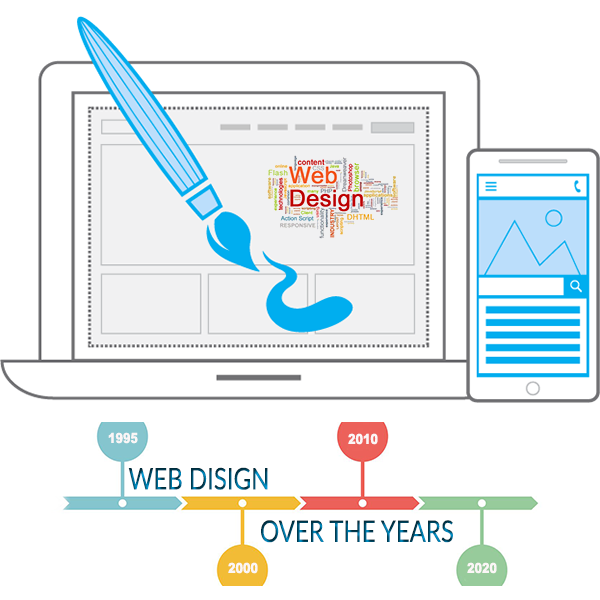
The second version of the web, also known as Web 2.0 (2003/4-2010)
This is most likely the design trend that most people remember, as it only died out a couple of years ago. This particular trend of design allowed websites to offer a better experience to their visitors, alongside with more features. Web designers spent a good period of time trying to make websites as easy to use. The trend included the use of oversized graphics and buttons, meant to encourage users to click more. Gradients, colours and few animations allowed visitors to familiarize themselves with the internet, and interpret the future of web design trends.
The Skeuomorphic design (2010-2012)
This particular type of design is considered to have been engineered by Apple, and implemented on their desktop and mobile platforms. Its main characteristic is to take real life objects, and add functionality to them. In return, this helps users feel a level of familiarity whenever they interact with the objects present in an app, or on a website However, while still present, designers are slowly moving away from this trend, and are now focusing more on website responsiveness, user experience, allowing visitors to find what they’re looking for as soon as possible, and eye-pleasing images.
Flat Design (2012- now)
This leads us to the current design trend, also known by the name of flat design. It is characterized by the absence of graphical elements that do not provide much of a purpose. In return, this has majorly simplified user interfaces. Decorative elements are avoided, whereas open space, sharp edges and bright colors are wanted. The main idea of flat design is to focus on usability, minimizing distraction, and allowing visitors to focus on content. The main benefit of flat design is its great rate of adaptability, which has become quite efficient, considering the fact that people view websites on a large array of devices.
Based on everything that has been outlined so far, the future of web design will likely evolve even more, with websites becoming easier to surf, and information becoming even more accessible.